Presentation Tools
Danielle Minor
Libraries in the digital age
Over the years, libraries have been an essential part of the academic and literary community. While times are changing; libraries have become digital yet are still offered to the public. Digital libraries are constructed through digitization, thereby further enhancing access to information. Because of the new formats and standards, Barbuti (2021) states the “Re-usable of FAIR Principles into R4”:
descriptive metadata over time foster their transformation in cultural sources and memory
(an example above all: the Flavian Amphitheater, that is the Colosseum);
to resist usury in order to guarantee the availability of the services provided"
(https://it.wikipedia.org/wiki/Resilienza), is the requirement to recover and reuse over
time descriptive metadata preserving the memory of their original function even in
transformation of their functions from practical to cultural.
Works Cited
Barbuti, Nicola. “Thinking Digital Libraries for Preservation as Digital Cultural Heritage:
By R to R4 Facet of FAIR Principles.”
International Journal on Digital Libraries, vol. 22, no. 3, Sept. 2021, pp. 309–18. EBSCOhost,
https://doi-org.ezproxy.palomar.edu/10.1007/s00799-020-00291-7.
Presentation tools in libraries

A brief clip on popular presentation tools
Works Cited
Badge, JoanneL., et al. “Assessing the Accessibility of Online Learning.” Innovations in Education & Teaching International, vol. 45, no. 2, May 2008, pp. 103–13. EBSCOhost, https://doi-org.ezproxy.palomar.edu/10.1080/14703290801948959.
Digital storytelling

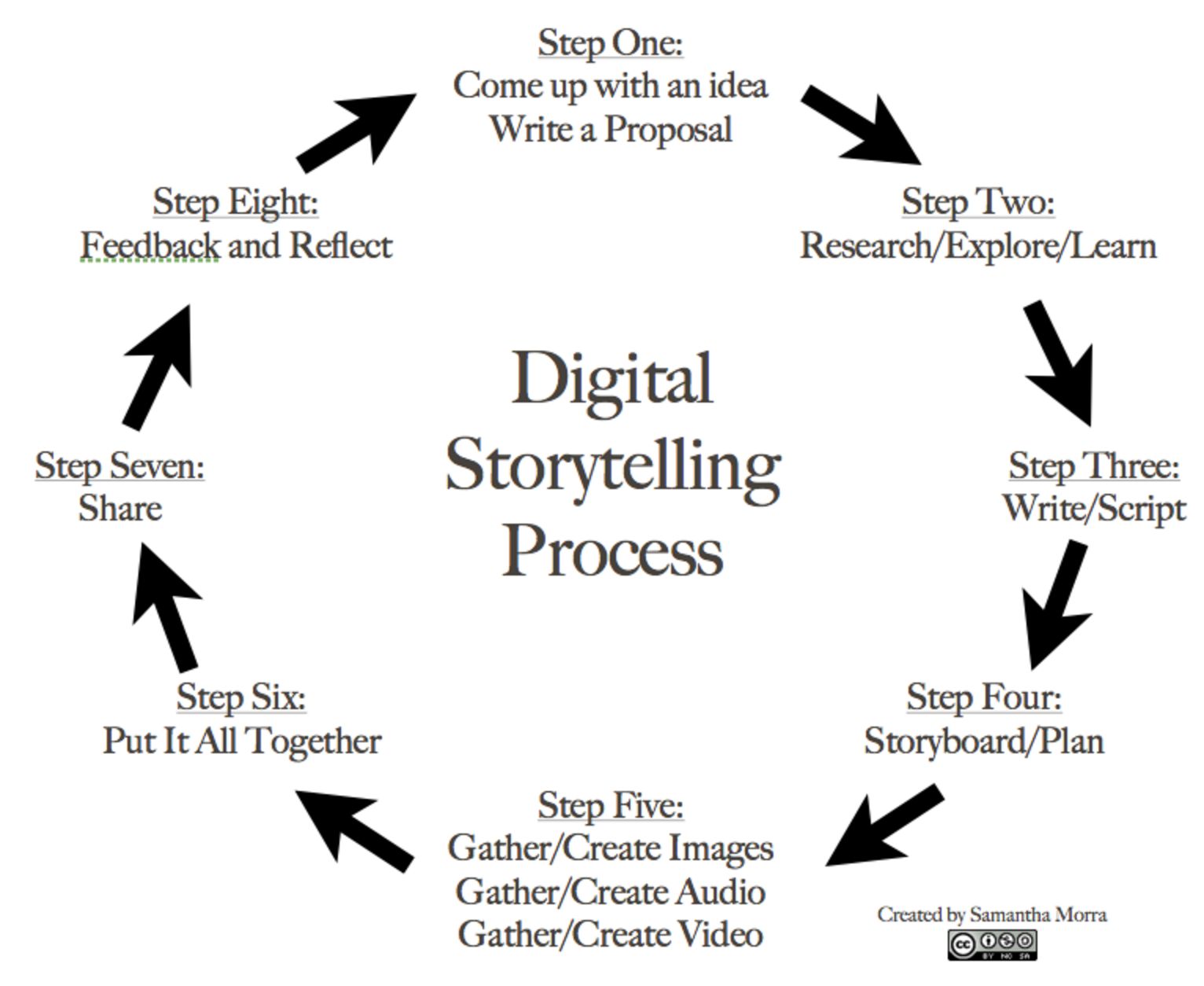
Libraries are known for their storytelling programs. These days; everything has become digital and now libraries are encouraging digital storytelling. Digital storytelling is a short form of digital media production that allows everyday people to share aspects of their story. Digital storytelling provides: creativity expression, collaboration, research, and resource selection. There are a few contradictions to storytelling; “Another important contradiction that emerged concerned differing viewpoints regarding adherence to archival standards” (Detlor, et al. 55). According to the abstract of “Digital Storytelling: An Opportunity for Libraries to Engage and Lead Their Communities”: Results suggest that digital storytelling is a viable mechanism by which memory institutions, such as libraries, can engage and lead their communities. These initiatives also offer opportunities for collaboration among institutions. However, libraries must heed a variety of challenges and concerns that can potentially limit or constrain these benefits”. This statement implies that there are limits to the benefits of digital storytelling.
The Process of digital storytelling
Works Cited
Detlor, Brian, et al. “Digital Storytelling: An Opportunity for Libraries to Engage and Lead Their Communities.” Canadian Journal of Information & Library Sciences, vol. 42, no. 1–2, Mar. 2018, pp. 43–68. EBSCOhost, https://search-ebscohost-com.ezproxy.palomar.edu/login.aspx?direct=true&db=lxh&AN=146114292&site=ehost-live&scope=site.
Virtual reality and libraries
As aforementioned in the previous post, “These days; everything has become digital”. This statement denotes that so many resources have become digital. Now there is the virtual notion to consider. Virtual reality has become accepted into the library. According to Hannah Pope: “Virtual and augmented reality (VAR) is not a new concept, but over the past couple of years, these technologies have become more accessible to the public, and libraries are at the forefront of this access” (5). Virtual and augmented reality has been exercised in the library. After conducting some research on the subject of virtual and augmented reality, Pope noted the following: “Libraries reported that they used virtual and augmented reality as a way to train workers, although responses to the survey did not detail how this was done” (9). It can be surmised that virtual and augmented reality contribute to effective learning in libraries for patrons, staff, and students.
Works Cited
Pope, Hannah. “Virtual and Augmented Reality in Libraries.” Library Technology Reports, vol. 54, no. 6, Aug. 2018, pp. 1–25. EBSCOhost, https://search-ebscohost-com.ezproxy.palomar.edu/login.aspx?direct=true&db=lxh&AN=131380062&site=ehost-live&scope=site.


No comments:
Post a Comment